
01The four loads a cure oven heater carries
Makeup and exhaust air
Every cubic foot exhausted must be heated from room temperature to set point. Load in kW = 1.08 × CFM × ΔT°F ÷ 3,412, divided by heater efficiency. This single line is why oven kW is usually driven by airflow, not by the burn-off chemistry.
Parts and fixtures
Mass × specific heat × temperature rise, spread over the ramp time. Steel jigs and trolleys often outweigh the product itself by three to five times, and they are heated on every cycle.
Walls, floor and door
Steady-state loss = U × A × ΔT. A well-insulated panel oven at 400°F air loses roughly 40-80 W/m² per °C of ΔT divided by 1000; a bare 1.5 mm sheet wall can lose five times that, and the door seam is where most of it goes.
Volatiles and purge
Solvent burn-off, nitrogen purge or a startup-only boost. Small in powder coating, significant in wet-paint ovens where the exhaust flow is set by the LEL limit rather than by the thermal need.
Add the four, then decide whether the oven is sized for continuous or batch duty. A batch oven that cools to ambient between loads must also recover temperature inside the load/unload window, which is a short-time duty with a peak several times the running average; a continuous tunnel oven runs at the average almost forever.
The practical consequence: in a continuous tunnel the heater is usually 20-40% of what an engineer guessing from the recirculation fan would calculate. Recirculation air only has to make up what was lost, not be reheated from scratch.
02Worked example, 20 ft tunnel, powder coat
Airflow
Exhaust/makeup 200 CFM, recirculation 6,000 CFM. Only the 200 CFM is a heating load: 1.08 × 200 × 340°F ≈ 73,440 BTU/h ≈ 21.5 kW at the duct, about 24 kW through the heater.
Parts and hangers
1,200 lb of steel product plus 2,600 lb of hangers per hour, ramped 70→397°F. m·cp·ΔT = 3,800 × 0.12 × 327 ≈ 149,000 BTU/h ≈ 44 kW.
Envelope loss
Roughly 260 m² of 100 mm mineral-wool panel at ΔT 170°C: about 30 kW running, plus 25 kW extra during the two-hour heat-up soak that the tunnel controller absorbs as a ramp allowance.
Total
Continuous duty lands near 95-110 kW, with a first-fire allowance of about 1.5×. A 120 kW heater bank in four steps of 30 kW covers it, and the bank is 4 m long at a watt density that keeps the sheath honest.
Every number above is an example, not a promise about your line; the arithmetic is what transfers. Note how the 6,000 CFM recirculation fan contributes nothing to the kW figure while contributing almost everything to the temperature uniformity.
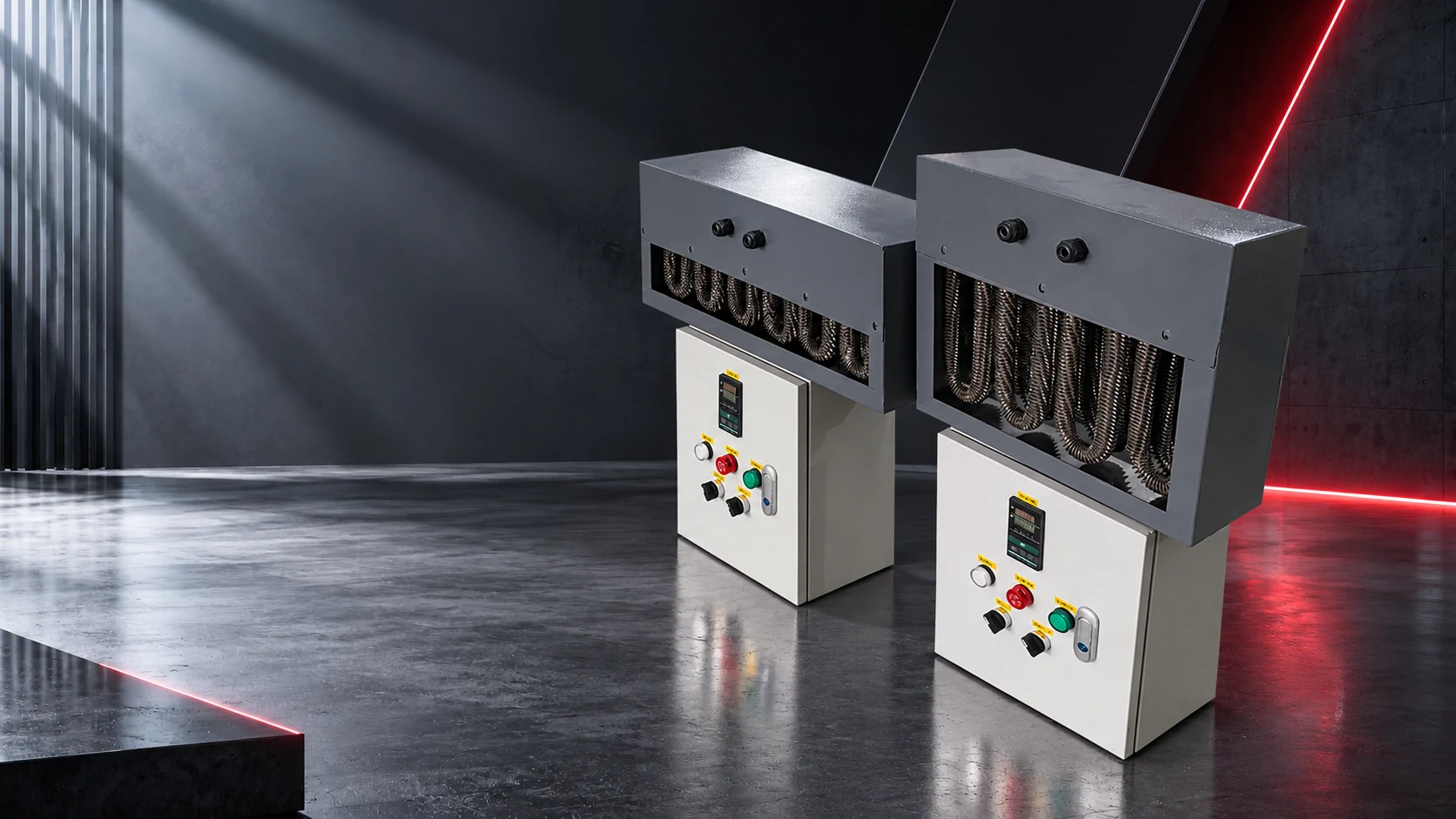
03Element layout in a recirculating oven
Watt density in moving air
3-5 W/cm² with the air moving across the bank at 3 m/s or more; 1-2 W/cm² if the oven is ever run with the fan at low speed or the ducts blocked. Curing ovens fail elements at low airflow far more often than at high temperature.
Bypass and short-circuit
In a plenum bank, some air finds the path of least resistance. If the elements are not in the throat of the flow, part of the bank sees almost no air and the sheath runs hot while the oven still shows set point.
Thermocouple placement
One sensor in the return air is not a product temperature. Put the control sensor in the working zone at part height, and a second one at the element outlet as a high-limit — the two together catch a stalled fan.
Control mode
Contactor switching in steps of 20-30 kW is fine for a tunnel; a SCR or zero-cross power controller is worth it where the ramp slope matters, because it holds temperature within a couple of degrees instead of cycling it.
A door that is opened on a batch cycle is a cold-air slug straight across the lowest elements. If your process opens doors frequently, put the first row of the bank back from the door and give it a lower watt density than the rest.
04What goes wrong on commissioning day
The most common field complaint is not "not hot enough" but "hot enough at the top, cold at the bottom". That is an airflow problem, and the heater is blamed for it. Measure the velocity profile across the element face before you add kilowatts.
The second is a tripping breaker on first fire, which is nearly always an inrush or an insulation issue in a bank that has sat cold and damp over a shutdown. Bake the element out at low power before the oven is loaded, and keep the last step of the ramp under 60% power for the first hour.
The third is a heater that was sized with a 2× safety margin "because ovens are hungry". Oversized banks in steps that are too coarse hunt, wear contactors, and make the oven temperature swing wider than the cure spec allows.